




|
Quantity
|
Out of stock
|
||
|
|
|||
|
|
|||
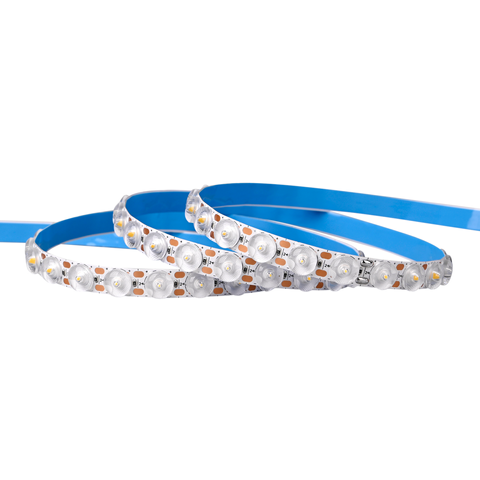
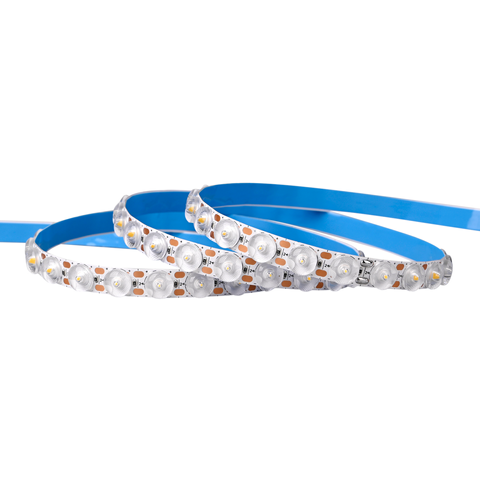
Wide-Angle Lens LED Strips Ulight LENS 170
Ulight LENS 170 wide-angle lens LED strip lighting is a flexible, low-voltage light source with 170° optics, designed primarily for backlighting diffusers and large illuminated surfaces. Unlike a conventional LED strip without dedicated optics, a lens-equipped strip spreads light over a wider area, helping adjacent LEDs' illumination zones overlap.
This diffuse LED strip is used in lightboxes, luminous stretch ceilings, wide-profile luminaires, advertising displays and decorative panels. A 170° beam angle alone cannot guarantee a streak-free result: lightbox depth, strip spacing, diffuser properties and operating temperature are equally important.
This category currently offers six LENS 170 variants operating at 24 V DC: single-color Mono at 3000 K and 4000 K, tunable-white CCT White Mix, and addressable SPI RGB. The same wide-angle optical concept is therefore available for fixed white lighting, adjustable white color temperature or dynamic color effects.
How 170° optics work: benefits and limitations
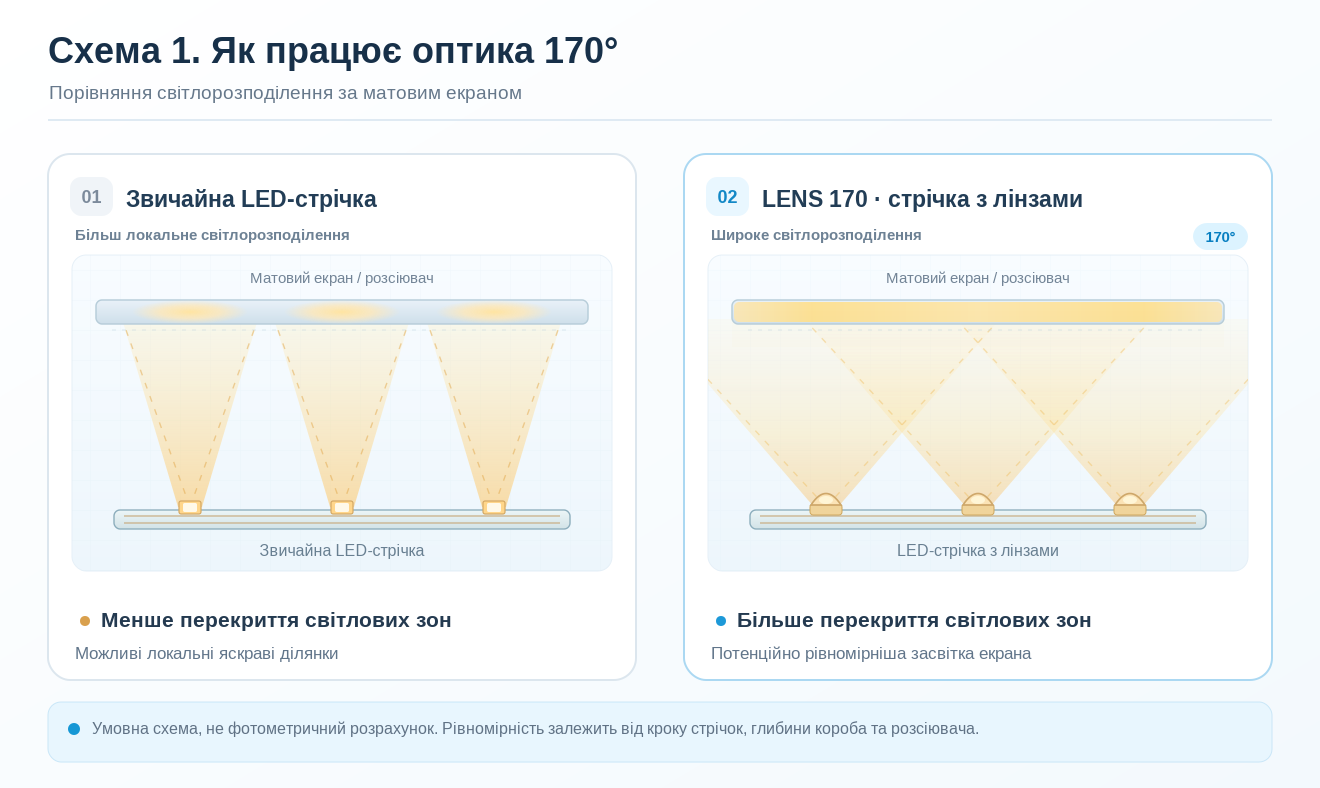
Wide light distribution instead of localized bright spots
Each LENS 170 LED works with a lens that distributes light over a wide angle. The illuminated areas from adjacent LEDs can overlap even at a relatively short distance from a matte diffuser. This helps reduce the contrast between bright LED points and darker gaps that may appear when conventional strip lighting is installed with unsuitable geometry.
Comparing practical backlighting approaches
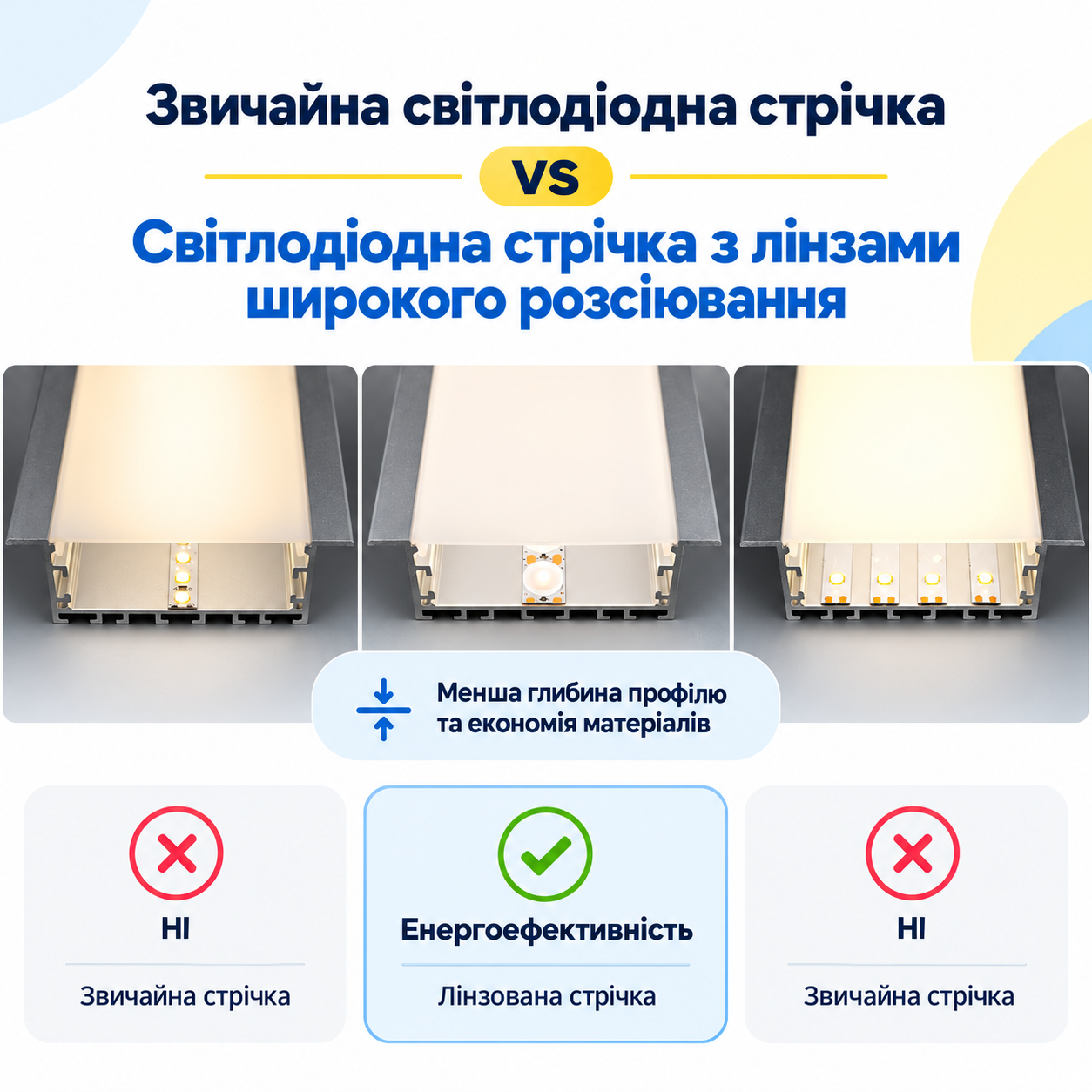
For the same profile, a design may require several lines of conventional strip or fewer lines fitted with suitable optics. Material savings are possible, but cannot be guaranteed for every construction: compare illuminance, uniformity, consumption and cost for the actual project.
Key benefits of Ulight LENS 170
- Broader overlap between illuminated areas — useful for matte diffusers, translucent ceiling membranes and lightboxes.
- Potential to reduce the number of parallel strip runs compared with conventional strips when the backlighting requirements are equivalent.
- Multiple lighting effects — fixed white light, tunable CCT or addressable RGB effects.
- One 24 V DC supply voltage across all models in this category.
Limitations: the strips are rated IP20, and higher-power versions require appropriate heat dissipation. Beam width alone does not determine screen illuminance in lux, installation spacing or brightness after the diffuser.
Ulight LENS 170 range: Mono, CCT and SPI RGB
The six products differ not only in color but also in LED density, power consumption and control method. Before choosing, decide whether the project requires fixed white light, adjustable white color temperature or programmable full-color effects.
| SKU | Light type | LEDs/m | Power | Control |
|---|---|---|---|---|
| a000168 | Mono, warm white 3000 K | 36 | 17 W/m | 1-channel PWM |
| a000169 | Mono, neutral white 4000 K | 36 | 17 W/m | 1-channel PWM |
| a000170 | Mono, warm white 3000 K | 60 | 24 W/m | 1-channel PWM |
| a000171 | Mono, neutral white 4000 K | 60 | 24 W/m | 1-channel PWM |
| a000172 | CCT White Mix, 2700–6500 K | 48 | 24 W/m* | 2-channel CCT |
| a000173 | Addressable SPI RGB, SM16703P | 42 | 8 W/m* | Compatible SPI controller |
All variants operate at 24 V DC and use 170° wide-angle lenses. *For CCT and SPI, verify the stated wattage against the operating mode in the individual model specification; the confirmed reel length for a000173 is 5 m. Check current product listings for availability, cut length and brightness specifications.
Mono: fixed white color temperature
For a project with a fixed white color, a single-color strip is sufficient. Warm white 3000 K suits residential spaces, restaurants and decorative displays; neutral white 4000 K is often selected for workspaces and advertising panels. Compare the 17 and 24 W/m versions by calculated light output, thermal conditions and the desired diffuser brightness. To adjust brightness, use dimmers for single-color LED stripsthat are rated for 24 V and the required load current.
CCT White Mix: warm-white and cool-white channels
Model a000172 combines warm-white and cool-white LED channels so that the color temperature can be adjusted within its specified range. This requires a CCT controller with two suitable PWM outputs. Follow the controller and strip documentation to set up the channels and determine the permitted load current.
SPI RGB: addressable full-color effects
Model a000173 uses the SM16703P protocol and is specified at 6 pixels/m. It is suitable for dynamic RGB backlighting, animations and interactive advertising displays. Unlike conventional RGB strips, an addressable SPI strip cannot be connected to a basic three-channel RGB PWM controller. It requires an SPI controller for addressable LED strips supporting the SM16703P protocol.
Where to use Ulight LENS 170 LED strips
The 170° wide-angle lenses help create even backlighting behind matte diffusers. Below are four typical examples of use in lightboxes, ceilings and profile luminaires.
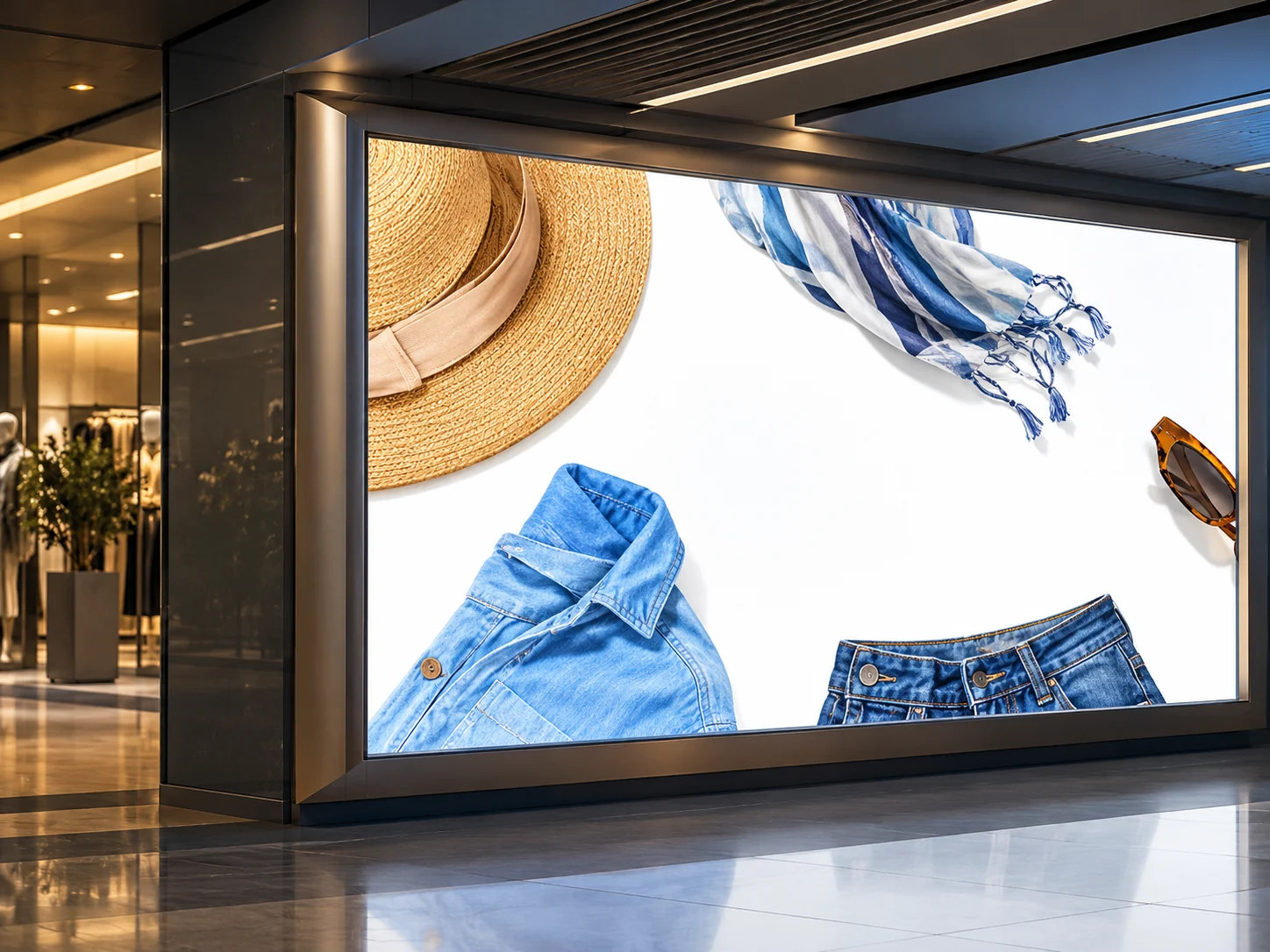
Lightboxes and illuminated advertising panels
Wide-angle distribution helps backlight large advertising surfaces evenly and reduces the visibility of individual LEDs behind a matte diffuser.
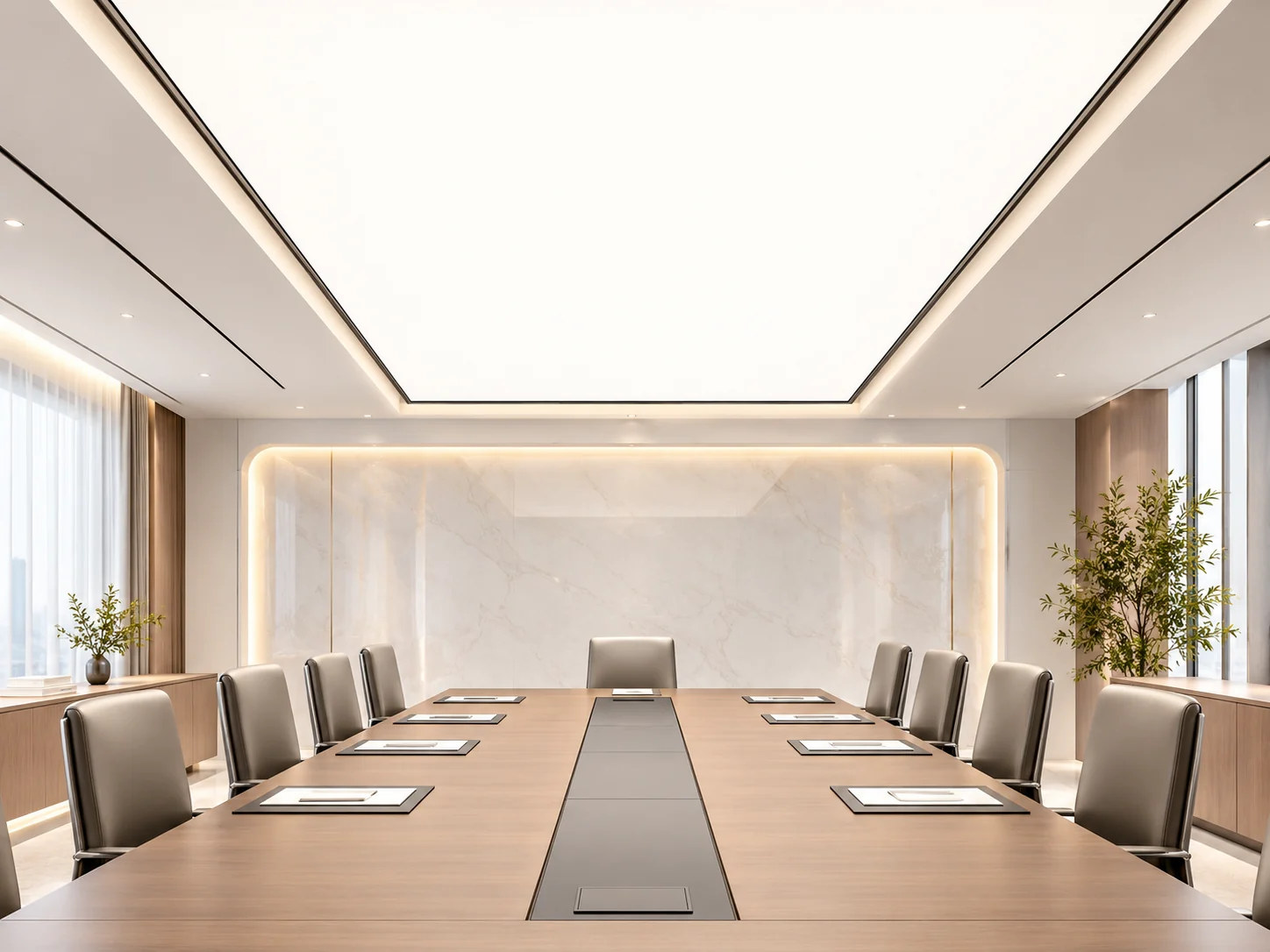
Luminous stretch ceilings
Lens-equipped strips are suited to backlighting large translucent ceiling areas in meeting rooms, offices and public interiors.

Linear office luminaires
Inside wide luminaire profiles, 170° optics help neighboring light zones overlap, producing more uniform illumination across the matte diffuser.

Illuminated ceilings in residential interiors
Uniform backlighting across a large area creates soft ambient light and highlights the architectural design of a home.
The illustrations represent typical applications. The final result depends on construction depth, spacing between strip runs, diffuser characteristics and the selected strip's luminous output.
Designing uniform backlighting: depth, spacing and diffuser
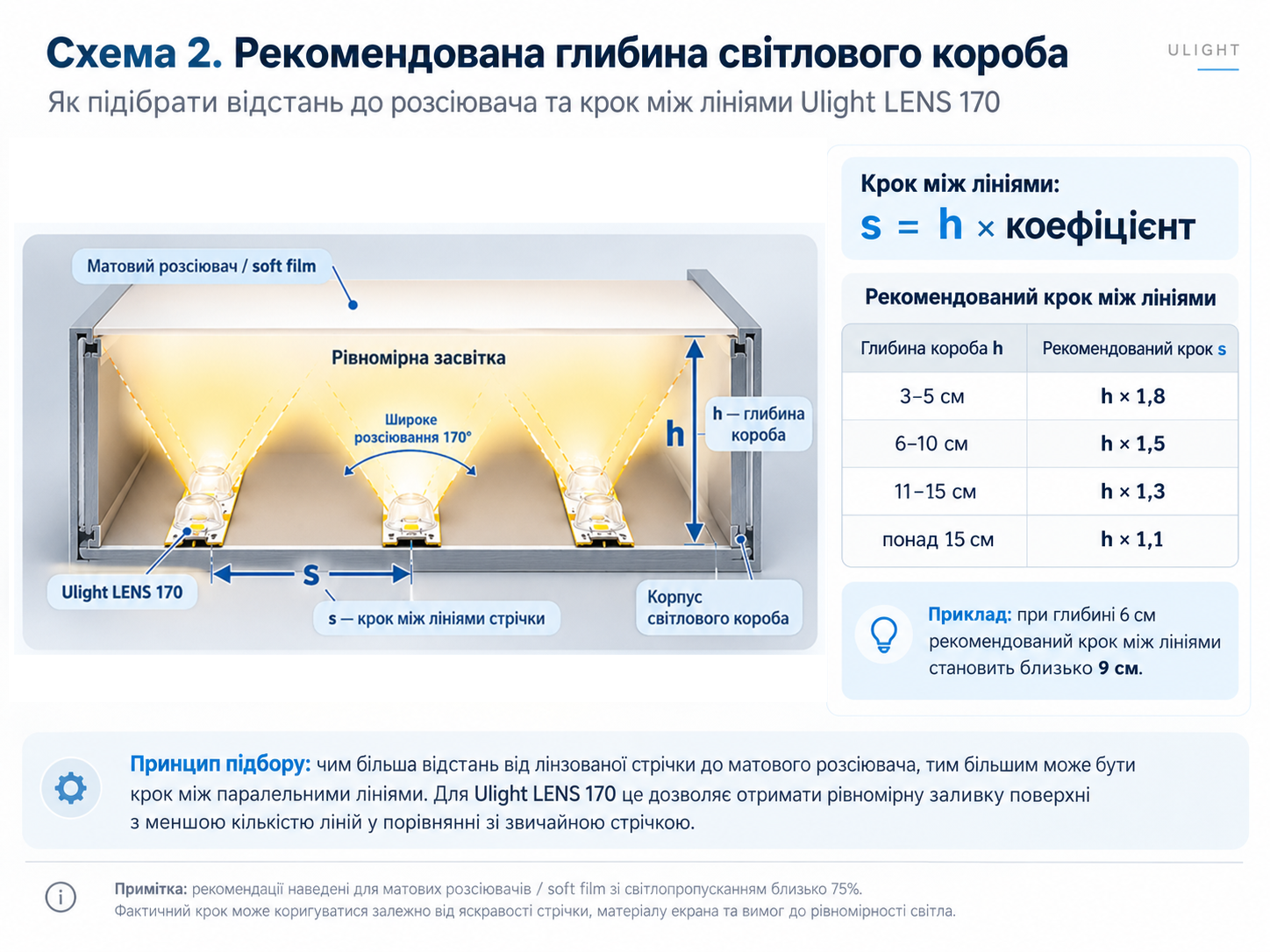
Start with the geometry of the illuminated area rather than the strip length: establish its dimensions, diffuser material, internal depth, target brightness and space for power supplies. With wide-angle optics, what matters is the relationship between the distance to the diffuser h and the spacing between parallel strip runs s.
Lightbox depth and strip spacing
The manufacturer of Ulight LENS 170 provides a table for lightboxes using a matte diffuser / soft film with approximately 75% light transmittance. The multiplier depends on depth. First measure the actual distance from the strip mounting plane to the diffuser, then multiply it by the factor for the appropriate depth range.
Spacing between runs: s = h × kh = box depth; s = center-to-center distance between adjacent runs; k = multiplier from the manufacturer's table.
| Depth h | Factor k | Spacing s |
|---|---|---|
| 3–5 cm | 1.8 | h × 1.8 |
| 6–10 cm | 1.5 | h × 1.5 |
| 11–15 cm | 1.3 | h × 1.3 |
| Over 15 cm | 1.1 | h × 1.1 |
Example: at a depth of 6 cm, the calculated spacing is 6 × 1.5 = 9 cm. The manufacturer's original illustration also shows 10 cm spacing for a 6 cm deep lightbox. These ratios are therefore best treated as design guidelines; verify final uniformity with a physical sample of the intended construction.
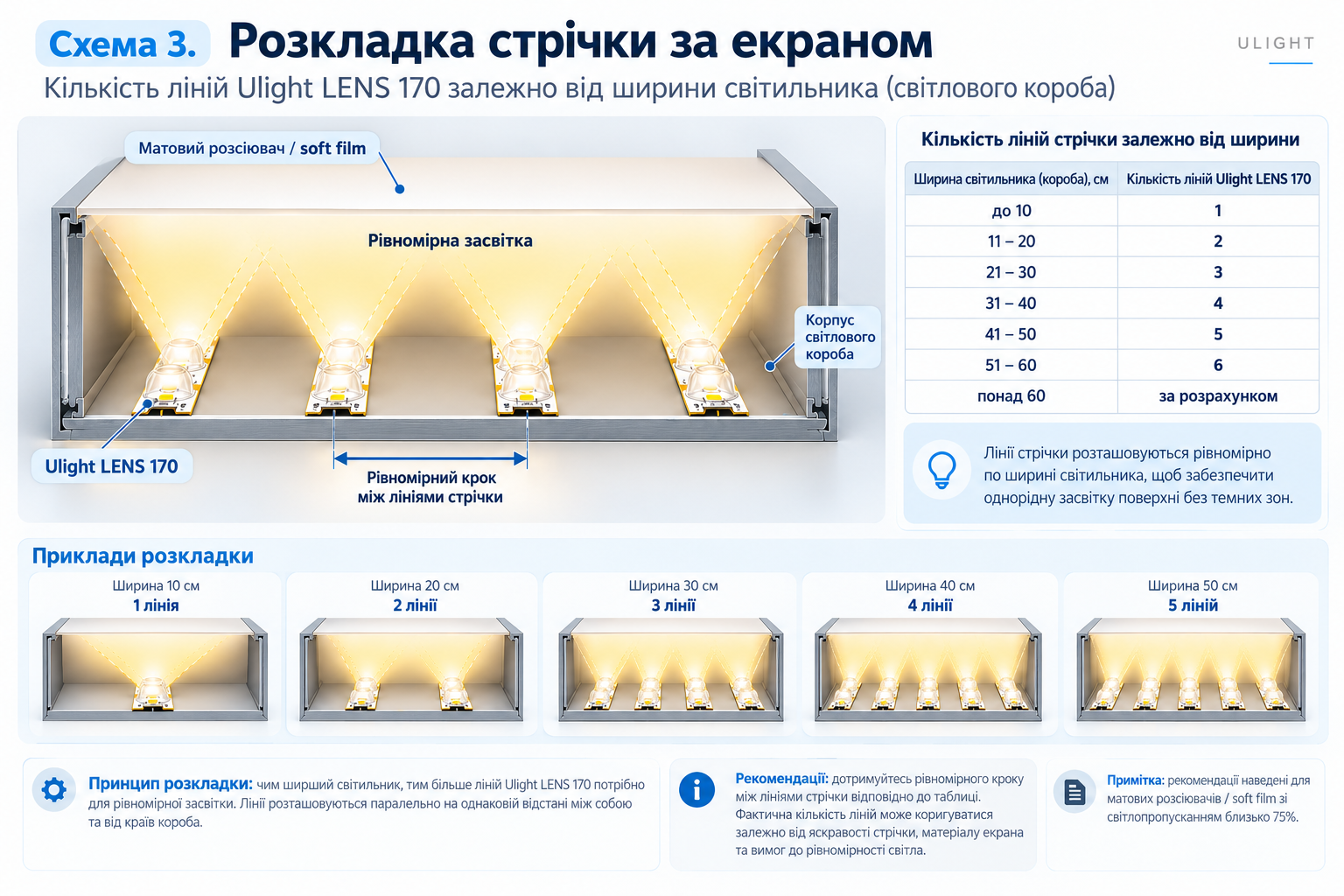
How many strip runs does a wide luminaire need?
A separate manufacturer table gives initial guidance for office profile luminaires: 5–10 cm width — one run; 10–20 cm — two runs; 20–30 cm — three runs. For the boundary values of 10 and 20 cm, verify the number experimentally because the tabulated intervals overlap.
Diagram 3 also illustrates how this approach may be extended to wider lightboxes. Values for widths above 30 cm are not backed by a separate manufacturer table: calculate the actual run count from the spacing table above, edge clearances, diffuser construction and the lighting specification.
How to prevent streaks, hot spots and excessive brightness
Keep parallel runs evenly spaced and account for the edges: a large gap near a wall can create a dark band, while an overly small gap can cause localized overlighting. Allow for variations in stretch membrane texture, joints and structural ribs. For large installations, build a sample using the actual diffuser material and intended operating brightness.
For onyx and other translucent materials, a separate trial is necessary: natural veining, varying thickness and transmittance create visible patterns even when the strip output is uniform.
Calculating strip length, power and 24 V supply requirements
From drawing to total strip length
Determine the number of parallel runs, their lengths, cable entry points and equipment locations. If the illuminated panel has several zones, calculate each separately and sum the lengths to plan the complete power system. Do not assume that reel length equals the maximum permissible distance for feeding power from one point.
PLED = L × PmL = total strip length in meters; Pm = specified power per meter; I ≈ PLED / 24 V for a nominal current estimate.
Example for Mono 24 W/m: 5 m × 24 W/m = 120 W. The nominal current is approximately 5 A. Assuming a 25% power-supply margin, choose a rated output of at least 150 W (24 V DC, rated output current of at least 6.25 A). This does not mean that all 5 m can necessarily be powered from one end.
What to check before choosing a power supply
- Total power demand for all runs and a suitable power-supply margin, typically around 20–30%, subject to installation conditions and equipment specifications.
- Current ratings of the dimmer or controller: its outputs must not be overloaded when all sections operate together.
- Voltage drop along the strip and cables: provide additional 24 V power feed points where needed for individual sections.
- Electrical safety: connect 230 V AC only to the power supply's mains input; downstream circuits must use compatible 24 V DC components.
Do not directly parallel the outputs of different 24 V power supplies unless the manufacturer explicitly permits it. Complex installations with multiple power sources need a dedicated power-zone and control layout.
To choose equipment, see 24 V power supplies for LED lighting and Ulight's power supply category.
Controllers and wiring diagrams for Mono, CCT and SPI RGB
Choose controls that match the lighting technology. Fixed-white Mono needs a single PWM channel; tunable-white CCT needs independent warm and cool channels; addressable RGB requires a digital SPI protocol compatible with the strip's specific IC.
| Strip type | Control device | Signal | What to check |
|---|---|---|---|
| Mono 3000/4000 K | 1-channel PWM dimmer | 24 V DC, PWM | Dimmer's rated current |
| CCT White Mix | 2-channel CCT controller | Separate WW/CW channels | Common conductor type and model-specific wiring |
| SPI RGB, SM16703P | Compatible SPI controller | DATA + 24 V power | IC compatibility, DATA direction, pixels/m |
Diagram 4 — wiring a single-color Mono strip
The power supply provides 24 V DC, a single-channel PWM dimmer controls brightness, and the strip retains its fixed color temperature. RF, wall panels, DALI and Wi-Fi describe possible control interfaces; the power output stage must match the Mono load and required current.
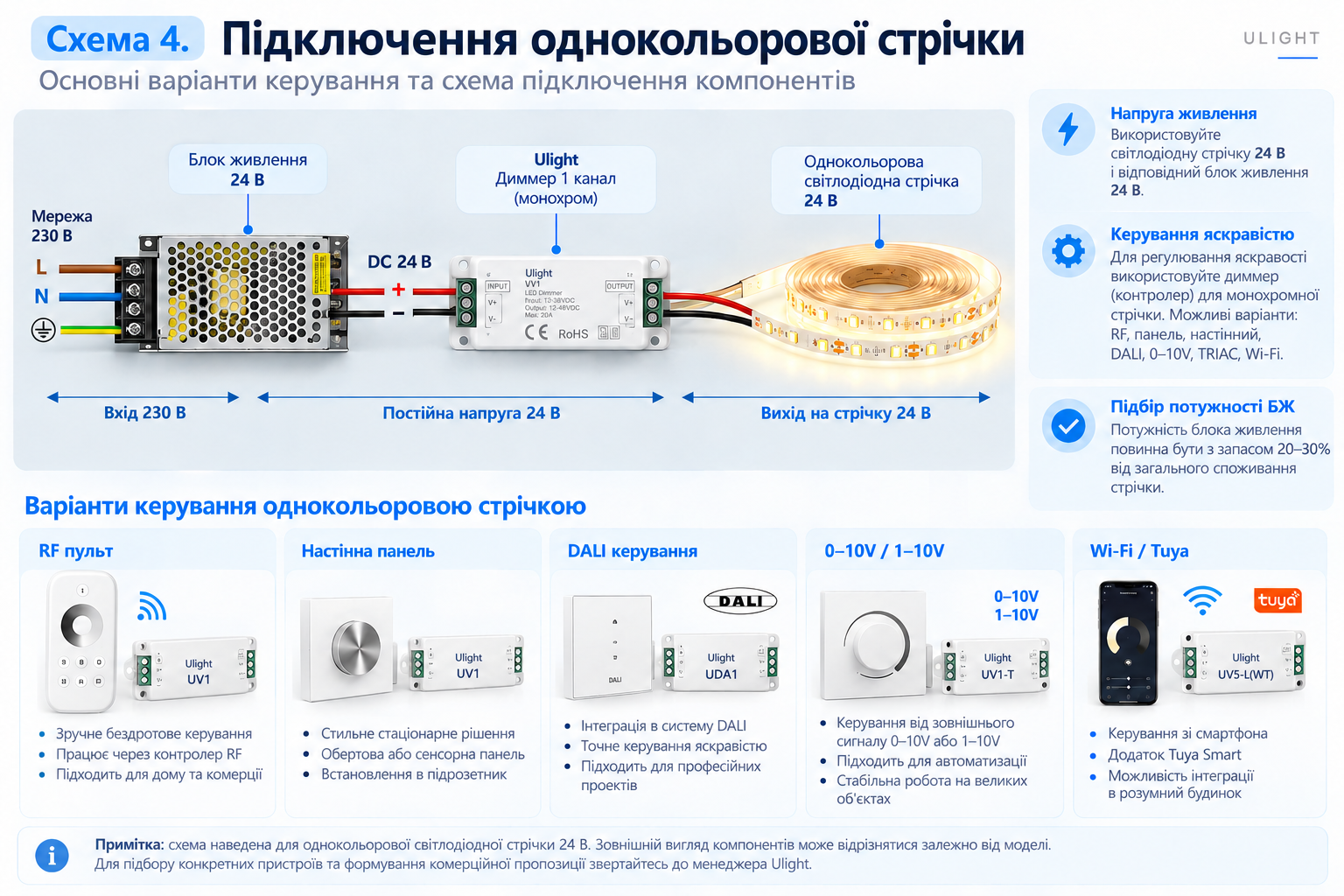
Diagram 5 — two-channel CCT White Mix
Model a000172 requires a CCT controller that independently adjusts warm-white and cool-white LEDs. Common conductor and channel terminal markings must match the documentation for the strip and controller. DALI DT8 can be used for CCT control if the particular device supports the required mode.
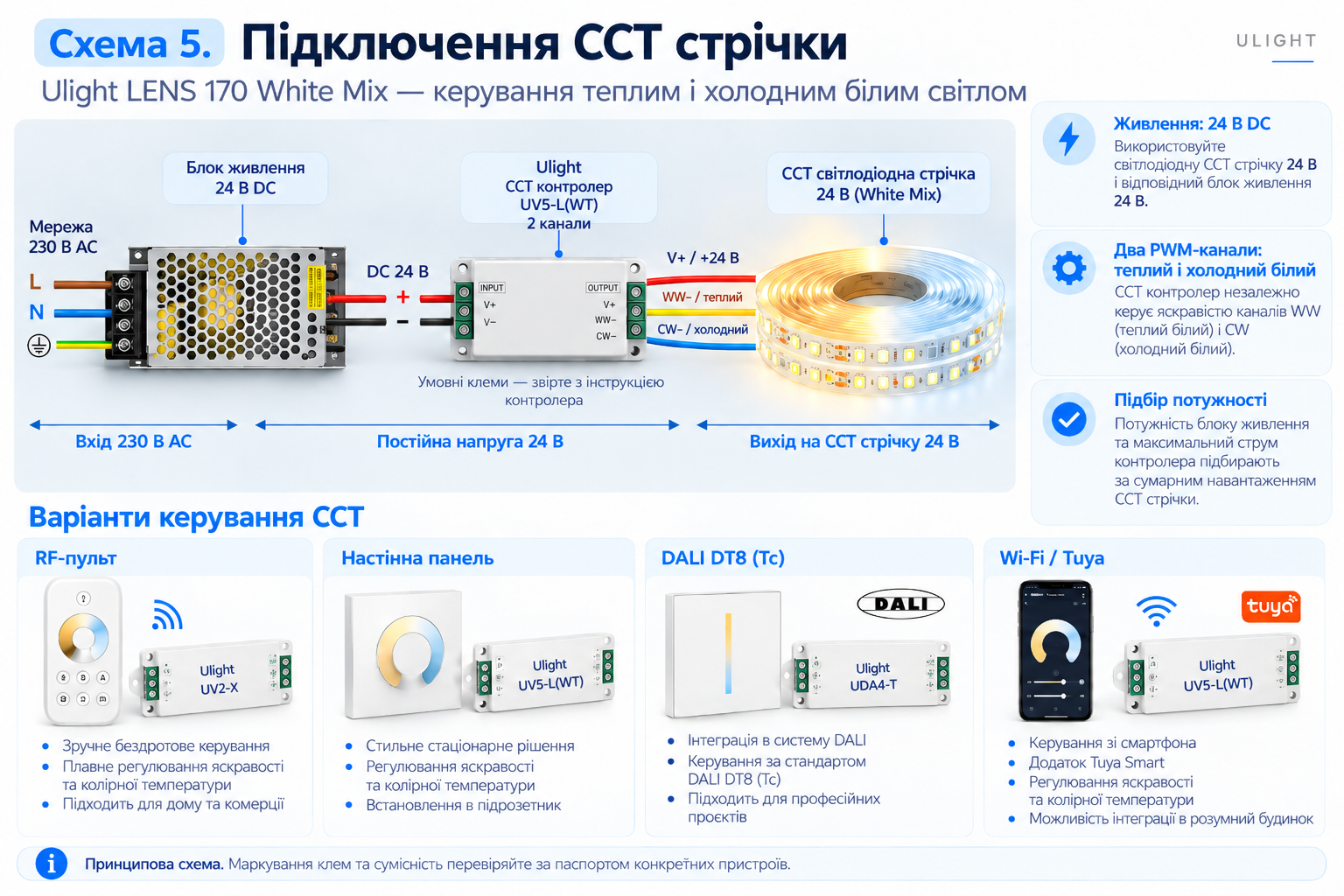
Diagram 6 — addressable SPI RGB with DATA
In SPI RGB systems, a digital controller sets each pixel's brightness and color. For a000173, the key requirements are compatibility with SM16703P, a pixel density of 6 pixels/m, correct signal direction towards the DIN input, and a shared signal ground. Add 24 V and GND feed points as required by voltage-drop calculations; use signal splitters or repeaters only as permitted by their documentation.
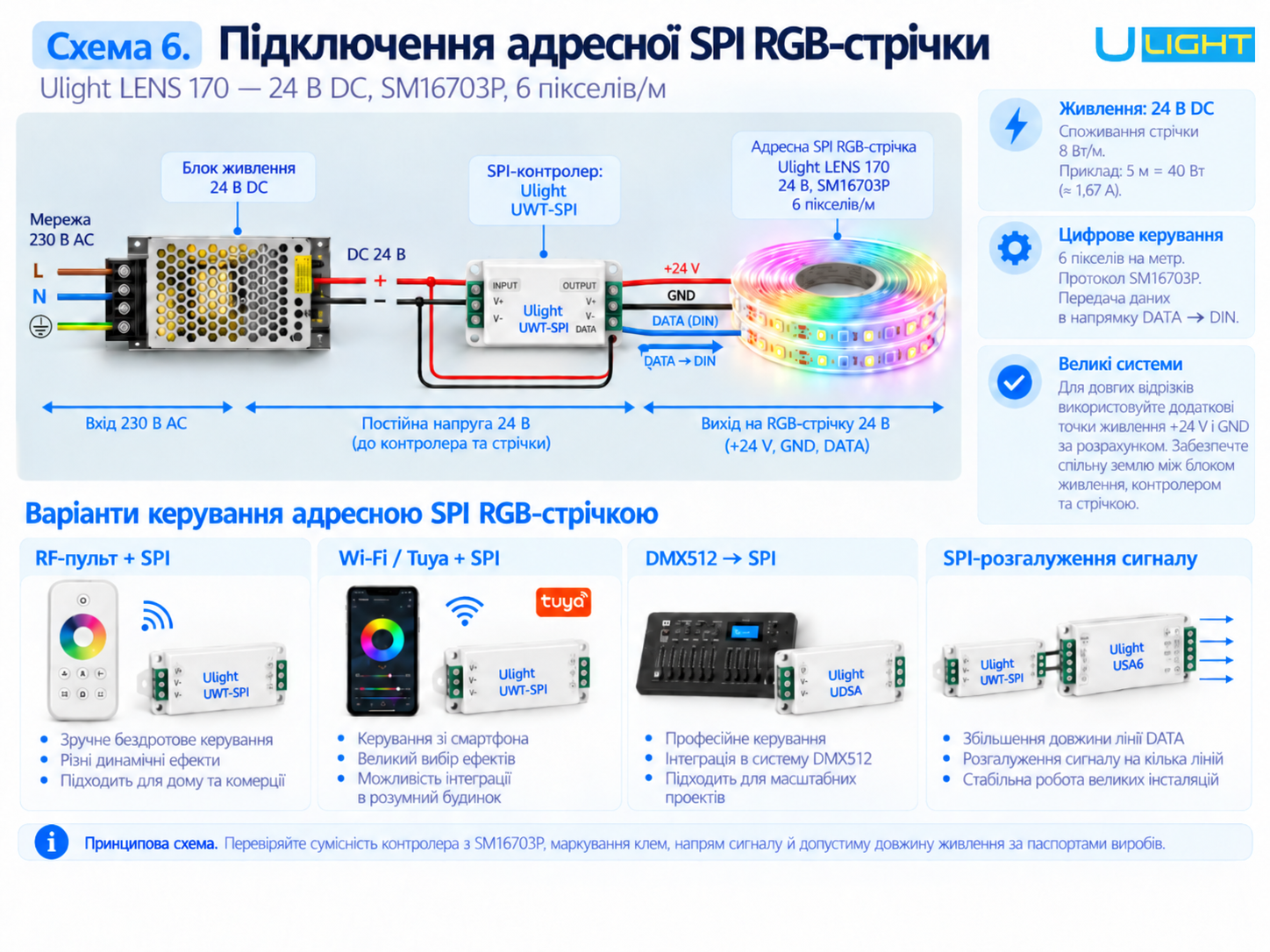
Important: all three wiring diagrams are conceptual illustrations. Device images, labels on rendered housings and generic terminals do not replace manufacturers' wiring diagrams. Before installation, verify actual terminal markings, current ratings and protocol compatibility.
Installation, heat management and system lifespan
Mounting surfaces and heat dissipation
Strips rated at 17 and 24 W/m can generate substantial heat. The mounting surface, thermal contact, ventilation within a closed lightbox and manufacturer recommendations are therefore important. Before installing on plastic, plasterboard or other thermally conductive or insulating materials, check heat-dissipation requirements and permissible operating temperatures.
Preparation, cutting and maintenance
Clean and degrease the mounting surface; adhesive alone is not a universal substitute for mechanical fixing. Cut the strip only at the manufacturer-marked points, protect contacts against accidental shorts, and keep power supplies and controllers accessible for servicing. Conceal cables carefully so that they do not cast shadows on the matte diffuser.
IP20 protection rating
All models currently listed in this category are rated IP20. They are intended for dry, protected installations, not direct exposure to water or outdoor mounting. Wet or exterior locations require a separate protective solution or a suitably protected LED strip.
LENS 170 vs conventional strips: comparing applications
| Strip type | Optical task | Typical applications | What to check |
|---|---|---|---|
| LENS 170, wide-angle distribution | Large illuminated areas behind a diffuser | Luminous ceilings, lightboxes, wide profiles | Depth h, spacing s, diffuser transmittance |
| Conventional single-color LED strip | Localized or linear illumination | Recesses, furniture, accent profiles | LED density, diffuser, distance to the screen |
| Lens-equipped strip for surface washing | Directional illumination of walls and facades | Architectural lighting, wall washing | Beam angle, distance from the wall, required uniformity |
Do not confuse wide-angle diffuser backlighting with directional illumination of architectural surfaces. Ulight offers a separate category for lens-equipped strips for washing walls and other surfaces. For general linear lighting, you can also explore 24 V LED strips.
How to choose a Ulight LENS 170 diffuse LED strip
- Define the lighting goal: uniform fixed-white illumination, adjustable color temperature or addressable color effects.
- Specify the construction: lightbox dimensions, diffuser thickness and transmittance, and where the strip runs can be mounted.
- Calculate spacing: use the manufacturer's table for soft film with around 75% transmittance; test a sample for other materials.
- Compare models: Mono 17/24 W/m and 3000/4000 K, CCT White Mix, or SPI RGB.
- Calculate electrical requirements: total length, power, number of feed zones, currents and control compatibility.
- Check installation conditions: cooling, service access, IP20 rating and illumination consistency near the edges.
Ulight engineer's advice: common design mistakes
Do not base spacing on the 170° angle alone
Consider box depth, diffuser properties and a test installation. A wide beam does not by itself guarantee the absence of bright spots.
Do not overlook the edges
Uneven spacing from the sides can produce darker or excessively bright strips along the illuminated surface.
Do not overload controller outputs
For Mono/CCT, verify channel current ratings; for SPI, verify protocol, signal wiring and power feeds.
Do not install high-power strips without evaluating cooling
At 17–24 W/m, appropriate heat dissipation helps maintain stable light output and service life.
Frequently asked questions about 170° lens LED strips
1. What are 170° lens LED strips used for?
For wide light distribution and more uniform backlighting of matte diffusers, luminous ceilings, lightboxes and wide-profile luminaires.
2. How is LENS 170 different from a conventional LED strip?
The lenses change light distribution, creating broader overlap between adjacent illuminated areas. With suitable geometry, this can make individual LEDs less visible.
3. Is LENS 170 suitable for a luminous stretch ceiling?
Yes, when the depth, spacing, power and translucent ceiling material have been selected correctly.
4. Can it be used in a lightbox?
Yes. This is a primary application: wide-angle optics help create a continuous glowing surface behind a matte panel.
5. How far should the strip be from the diffuser?
The required distance depends on the construction. For soft film with approximately 75% transmittance, the manufacturer provides depth ranges starting at 3 cm and factors for calculating run spacing.
6. What spacing should I use between Ulight LENS 170 runs?
For a known depth h, calculate s = h × k, where k is 1.8, 1.5, 1.3 or 1.1 depending on the box depth range. Verify the result against the actual diffuser before installing.
7. How can I avoid visible lines and bright spots?
Keep spacing and edge clearances consistent, prevent shadows from cables and housing ribs, and test a sample using the real diffuser.
8. Should I choose 17 or 24 W/m?
Consider the brightness needed after the diffuser, acceptable heat output and overall power budget. Higher wattage does not always mean better uniformity.
9. What is the difference between 3000 K and 4000 K?
3000 K produces warmer white light; 4000 K appears more neutral. Choose based on the interior, a sample of the ceiling film and the lighting goal.
10. What controller is needed for CCT White Mix?
A two-channel CCT PWM controller compatible with 24 V and the specific common-conductor arrangement and WW/CW channels.
11. How do you control the addressable SPI RGB model?
With a controller supporting SM16703P and the correct pixel settings. A standard RGB PWM dimmer cannot provide addressable control.
12. How do I size a 24 V power supply?
Multiply length by the specified wattage per meter, add a justified margin, and verify channel loads, cable sizing and voltage drop.
13. Can the strip be installed in damp locations?
The current LENS 170 models are rated IP20 and are not intended for direct moisture exposure. Use a suitably protected version or a separately engineered enclosure solution.
14. How is LENS 170 different from a lens strip used for wall washing?
LENS 170 is primarily designed for broad coverage behind a diffuser. Wall and facade washing instead requires luminaires or strips with directional optics.
Selection and ordering of Ulight LENS 170 LED strips
For a luminous stretch ceiling, advertising lightbox or wide linear luminaire, it is important to specify more than just a “170° LED strip”: you need a complete systemcovering the Mono/CCT/SPI effect, strip spacing, total power, controllers, 24 V power supplies and the diffuser. Ulight can help prepare a bill of materials based on your drawings, dimensions and installation conditions.
Send us your construction dimensions, depth, diffuser material and desired lighting effect. We can help specify everything required for a single luminaire, a series of lightboxes or a large installation.