Type your phone number and we will call you back shortly
Single Color LED Strip Lights
Sort:
View:
Single-Color LED Strip Lights for Interiors and Professional Projects
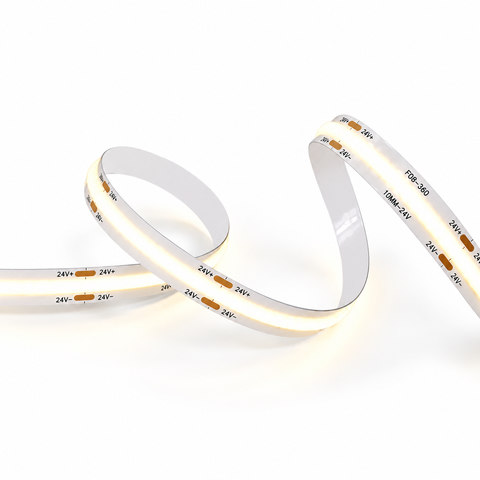
Single-color LED strip lights (Mono LED strips) are flexible light sources operated through a single control channel. The light color is determined by the specific model, while brightness can be adjusted with a compatible dimmer where required. In this Ulight selection you can choose white LED strip lights with warm-white light at 3000 K or neutral-white light at 4000 K.
Single-color LED strips are used to illuminate kitchens, furniture, niches, ceiling coves, shelves, display cases, and linear luminaires. With adequate luminous flux and thoughtful placement, they can also contribute to general lighting. The result depends not only on strip wattage but also on luminous efficacy, mounting method, diffuser, power supply, and thermal management.
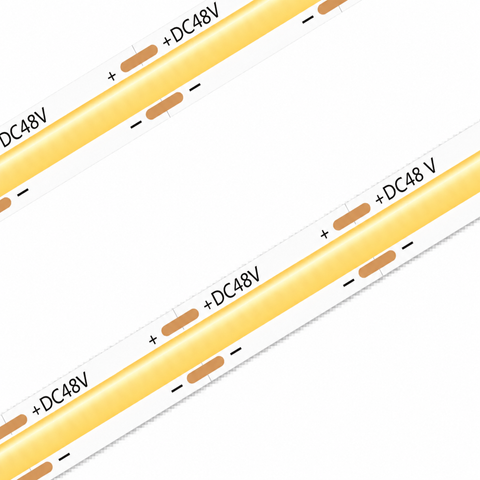
The Ulight category includes single-color LED strips with 1 CH (Mono) control. Available models operate at 24 V and 48 V DC, with warm-white options at 3000 K and neutral-white options at 4000 K. Check the product page for the color rendering index, IP rating, SMD/COB technology, power consumption, and maximum permitted powered length. The category assortment may change.
1 CH Mono24 / 48 V DC3000 / 4000 KChoose by CRI, IP rating, and wattage
What Is a Single-Color LED Strip and How Does It Differ from Other Types?
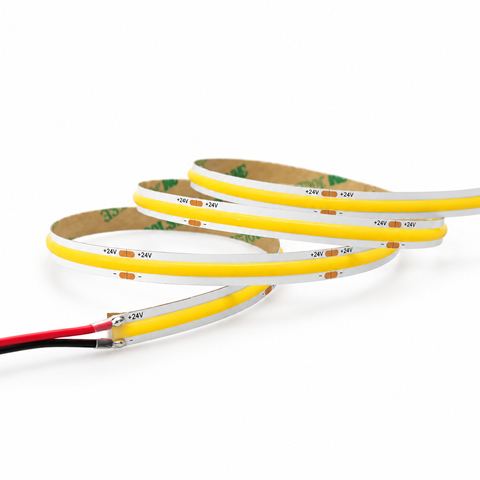
The term Mono refers to the number of control channels, not to the LED packaging technology. A standard white strip with a fixed color temperature, whether SMD or COB, typically has two power connections: “+” and “−”. Switching and brightness adjustment can be implemented with a compatible power supply and a single-channel PWM dimmer.
Single-color, CCT, RGB, and SPI: which to choose
Type
What changes
Control
Typical application
Mono
Brightness of one fixed color
1 channel, typically PWM for constant-voltage strips
Fixed white illumination and linear lighting
CCT / Tunable White
Brightness and color temperature
Usually 2 channels for warm and cool white
Adjustable lighting ambience throughout the day
RGB / RGBW
Light color and intensity
3 or 4 channels, depending on the model
Decorative color scenes
Addressable SPI
Effects on individual pixels or pixel groups
Digital data signal and a suitable controller
Dynamic animations and chasing-light effects
Important: if you need adjustable white tones, choose CCT / Tunable White models. A standard single-channel white LED strip does not become a tunable-white strip simply by adding a dimmer.
Where Single-Color LED Strips Are Used: From Kitchens to Commercial Lighting
For designers, architects, electricians, installation contractors, and integrators, single-color LED strips are a versatile option for linear lighting. Agree on the lighting task, installation details, strip specifications, power requirements, and control method before ordering.
Kitchens and worktops. Provide even lighting for countertops beneath wall cabinets. Choose an appropriate angled or recessed profile and diffuser as well as the strip to prevent direct glare.
Ceilings, coves, and niches. Plan concealed lighting with the distance to the illuminated surface in mind: even COB strips cannot guarantee perfect uniformity if the cove geometry is unsuitable.
Furniture, shelving, and wardrobes. Use compact strips and profiles, provide suitable cable entry points, and allow access to the power supply for servicing.
Shops, showrooms, and display cases. Prioritize accurate product color rendering, predictable brightness, and consistent color temperature across different light runs.
Offices and public spaces. Consider linear luminaires in profiles, target illuminance, glare, and control-system compatibility.
General lighting. Possible when the combined luminous flux and lighting design deliver adequate illumination. Power in W/m alone does not guarantee the required illuminance.
For repeatable projects, specify the strip product code, color temperature, CRI, luminous flux, width, maximum powered section length, profile, and driver/dimmer model. This reduces the risk of purchasing and installation errors.
White LED Strip Lights: Warm, Neutral, or Cool White?
White LED strips are available in different shades of white. Color temperature is expressed in kelvin (K): lower values generally appear warmer. This is not the physical operating temperature of the strip.
Guide to white light color temperature
Color temperature
Appearance
Suitable uses
3000 K
Warm white
Bedrooms, living rooms, cozy areas, decorative niches
4000 K
Neutral / daylight white
Kitchens, worktops, shelving, offices
The current selection includes 3000 K and 4000 K; cooler white options are not currently listed here. To compare specifications, see our separate selections of warm-white LED strips and daylight-white LED strips. Aim for consistent color temperature across light sources in the same room. Actual shades may vary slightly between product series and manufacturing batches.
Why CRI Matters as Much as Color Temperature
CRI (Ra) describes how faithfully illuminated objects’ colors appear compared with a reference light source. For residential, retail, and design applications, it often makes sense to consider strips with CRI ≥ 90, although the project determines the exact requirement. A higher CRI does not automatically mean higher brightness or a complete description of the emitted spectrum; color-critical applications require additional light-quality parameters.
SMD vs COB: How the Technology Affects the Light Line
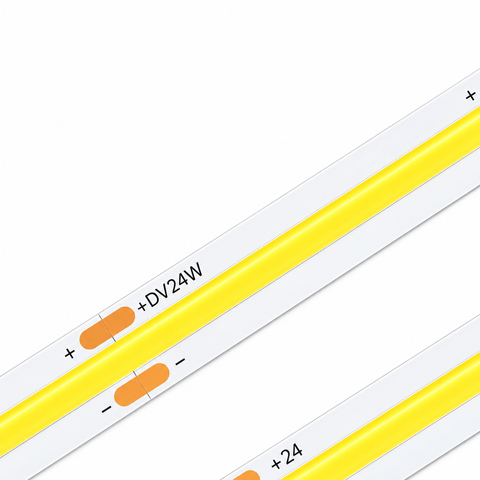
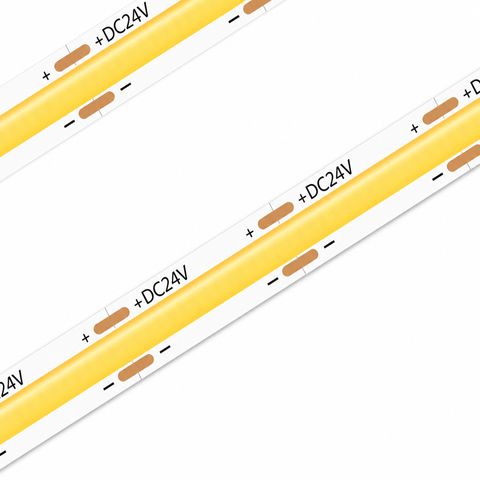
SMD strips use individual packaged LEDs mounted on a circuit board. COB uses densely arranged light-emitting elements and typically produces a more continuous-looking light line. Both technologies can be single-channel Mono strips emitting white light; the packaging technology alone does not determine CRI, voltage, efficiency, or warranty.
Practical technology comparison
Criterion
SMD
COB
Visibility of individual LED points
Depends on LED density and the diffuser
Individual points are usually less visible
Installation in a shallow profile
Check uniformity with the diffuser in place
Often convenient for an even light line
Luminous flux
Depends on the specific model
Depends on the specific model
Heat dissipation
Required according to power and installation conditions
Required according to power and installation conditions
Main selection criteria
lm/m, W/m, CRI, LED pitch, and construction
lm/m, W/m, CRI, width, and installation conditions
Selection tip: Single-color operation depends on the control channel, not the LED mounting technology. Compare individual SMD and COB models by luminous flux, uniformity, width, CRI, and cooling requirements. More continuous-light options can be found in our COB LED strip category.
What Specifications Matter When Choosing a Single-Color LED Strip?
Luminous flux (lm/m). Indicates the amount of light emitted per meter. It is more useful for comparing lighting output than W/m alone.
Power consumption (W/m). Determines energy use, power supply load, and heat dissipation requirements.
Luminous efficacy (lm/W). Indicates how much light is produced per watt consumed. Compare data measured under equivalent conditions.
Color temperature (K) and CRI. Affect how interiors, materials, food, and merchandise appear.
Supply voltage. The strip and power supply must match: for example, 24 V DC strip with 24 V DC supply, and 48 V DC strip with 48 V DC supply.
Width and height. The strip must physically fit inside the profile, allowing for wires, solder joints, or connectors.
Minimum cutting length and maximum powered section length. Cut only at the manufacturer's marked points. The maximum permitted powered length depends on the specific strip design.
IP rating and operating temperature. At the time of review, this category includes IP20 strips for dry indoor locations. Where splashes, condensation, or direct water contact are possible, choose a purpose-designed protected solution and check the IP ratings of every system component.
For an accurate choice, verify strip width, W/m, lm/m, operating voltage, CRI, and IP rating as well as the maximum powered length against each product page. Use the catalogue filters to check current specifications and availability.
24 V or 48 V: Choosing the Supply Voltage for LED Strips
In low-voltage lighting installations, 24 V DC LED strips are widely used. They are practical for furniture, ceiling coves, and profile-mounted light lines. Ulight also offers certain 48 V models for extended lighting runs, provided that the power supplies and dimmers are compatible.
For the same power, the current at 48 V is half that at 24 V (I = P / U). This can reduce cable losses when other conditions are equal. However, a 48 V rating alone does not guarantee an arbitrary maximum connection length: that depends on the specific strip circuit, conductor cross-section, and manufacturer’s specifications.
Calculating Power Supply Capacity and Light Output
For an initial estimate, multiply the strip power per meter by the total installed length. Then allow suitable headroom based on cooling, duty cycle, and the manufacturer’s recommendations.
P(strip) = P(per meter) × L
P(power supply) ≳ P(strip) × 1.25–1.30 — a general initial sizing guideline, not a substitute for manufacturer specifications.
Calculation example
Suppose you need to install 6 m of 24 V LED strip rated at 12 W/m:
Connected load: 6 × 12 = 72 W.
With an indicative 25–30% headroom: 90–93.6 W.
A practical choice is a quality 24 V power supply rated at least 100 W, provided its installation and operating conditions allow this.
Approximate total current: 72 / 24 = 3 A. Allow for this current and the cable run length when choosing conductors and a dimmer.
If the selected strip is rated at 1000 lm/m, six meters provide a nominal 6000 lm before losses in the diffuser and room. This alone does not determine illuminance in lux: floor area, geometry, reflectance, mounting height, and light distribution must also be considered.
During design, check the power supply's actual output current, PWM dimmer current rating, total voltage drop along cables, temperatures inside the cove, and service access. A separate selection of 24 V power supplies is available.
Single-Color LED Strip Wiring Diagrams
Six typical wiring arrangements for constant-voltage single-color LED strips. For the Ulight models in this category, consider 24 V or 48 V and select matching power supplies, dimmers, and amplifiers.
Without brightness control
Diagram 1. One LED strip — one power supply
One section; length and power must comply with the strip specifications.
Diagram 2. Several sections — one power supply
Sections are connected in parallel. Do not feed a second reel through the first reel's tracks.
Diagram 3. Separate power supply for each section
Each power supply has its own DC circuit. Do not join the DC outputs of separate supplies.
With brightness control
Diagram 4. One strip with a PWM dimmer
Use a single-channel PWM dimmer rated for the strip voltage and current.
Diagram 5. Several sections with one PWM dimmer
All sections connect in parallel to the dimmer output. Check the total load current.
Diagram 6. Dimmer and amplifiers for several sections
Each amplifier supplies its own strip; confirm PWM input compatibility in the device manual.
Important. These are principle diagrams, not site-specific installation plans. Dimmer and amplifier terminals and voltage limits depend on the actual equipment; for 48 V, choose only devices explicitly rated for 48 V. Observe polarity, current ratings, conductor size, allowable run lengths, and cooling requirements. Mains connections (~230 V) must be handled by a qualified electrician. Crossover arcs indicate wires without electrical contact; junction dots indicate electrical connections.
How to Choose a Single-Color LED Strip for Your Project
Selection guidelines for typical projects
Application
What to consider
Important note
Decorative cove lighting
COB, light uniformity, color temperature, strip width
Distance to the illuminated surface affects visible non-uniformity
Total lumens, light distribution, CRI, heat dissipation
Calculate illuminance rather than relying on W/m alone
Display case or showroom
CRI, color temperature, batch consistency
Check actual material colors using a sample
Long linear lighting run
Voltage, maximum powered length, supply arrangement
Calculate voltage drop and power injection points
Damp or dusty area
A separate range of protected LED strips and an appropriate IP rating for the whole system
The current IP20 range is not suitable for wet locations; connections and supplies need separately assessed protection
Engineer’s Advice: Common Selection and Installation Errors
Choosing on W/m alone
Two strips with identical wattage may emit different amounts of light. Compare specified lm/m with the actual lighting task.
Incorrect voltage
A 24 V strip needs a 24 V DC supply. Mixing 24 V and 48 V equipment without checking compatibility may cause damage.
Overloading the dimmer
Add the current drawn by every section connected to one output, and respect the dimmer’s rated output current and cooling requirements.
Insufficient heat dissipation
Do not enclose high-power strips in thermally insulated cavities. An aluminum mounting surface, good thermal contact, and ventilation support long service life.
Long run with power fed from one end
Uneven brightness at the far end often results from voltage drop. Use the manufacturer’s permitted power feed arrangements.
Inadequate protection of connections
A water-resistant strip does not automatically make solder joints, connectors, power supplies, or the installation recess waterproof.
Recommendation for installation contractors: before closing coves or ceilings, check polarity, actual voltage at the start and end of the line, temperature after prolonged operation, dimming scenarios, and future access for component replacement.
Frequently Asked Questions About Single-Color LED Strips
What is a single-color LED strip?
It emits one fixed color and is typically controlled by a single Mono channel. On a white strip, normal dimming does not change the selected color temperature.
How does a white single-color LED strip differ from CCT?
A white Mono strip has a fixed color temperature. A CCT strip combines two types of white LEDs and can adjust their balance when used with a compatible controller.
Which produces a more uniform light line, SMD or COB?
COB more often produces a visually continuous line. However, uniformity also depends on the distance to the diffuser, profile geometry, and diffuser characteristics.
Can LED strips be used for general lighting?
Yes, provided the luminous flux and lighting design deliver the required illuminance and visual comfort. Calculations should account for losses, mounting height, and the room.
Should I choose 3000 K or 4000 K for a kitchen?
3000 K usually appears warmer and cozier, while 4000 K is more neutral. Consider your other luminaires, interior finishes, and personal preferences.
What does CRI 90 mean?
It indicates a color rendering index (Ra) of approximately 90 or higher, as specified for the particular model. CRI helps assess how naturally colors appear; it does not measure brightness.
Is an aluminum profile always necessary?
That depends on power, strip construction, and mounting conditions. A profile is often recommended for neat light lines, protection, and heat dissipation; follow the specific strip’s installation requirements.
Can I connect a 24 V LED strip to a 48 V power supply?
No. The power supply's nominal output voltage must match the strip's nominal supply voltage.
How can I dim a single-color LED strip?
Use a compatible PWM dimmer designed for constant-voltage LED strips, or another control method supported by the system. Check voltage, current rating, and output type.
Why is the end of a long strip dimmer?
A common cause is voltage drop along the strip's copper tracks and the feed wires. Proper load distribution and permitted additional power feed points can help.
Can I cut an LED strip anywhere?
No. Cut only at the marked cutting points. The minimum section length depends on the model.
What IP rating do I need in a kitchen or bathroom?
This category currently features IP20 strips for dry indoor locations. Areas exposed to splashes, moisture, or condensation need a suitably protected strip and protection of every joint, power supply, and mounting assembly. See IP65 LED strips, taking the project conditions and requirements into account.
Can I connect two 5 m reels end-to-end?
Not every model allows this without affecting performance. Follow the manufacturer's maximum powered length and recommended wiring arrangement, not just the reel length.
How do I size an LED strip power supply?
Multiply W/m by the installed length, add justified headroom, and check voltage, current, cooling conditions, and the manufacturer's requirements.
Buy Single-Color LED Strips from Ulight and Specify a Complete System
A dependable lighting system needs more than the strip itself. We can help you coordinate color temperature and light output and select a compatible power supply, dimmer, aluminum profile, and wiring arrangement for your project.
For a calculation, tell us the total lengths, preferred 3000 K or 4000 K light, 24/48 V supply, mounting method, and whether dimming is required. Wet locations require a differently protected product. Designers, architects, electricians, and contractors can send a project specification to help us select the right equipment.